Pick a simple story moment.
Grade 5 · Laser & Vinyl · Lesson 02
Light & Shadow Story Machine
Engineer layered silhouettes that communicate a story through light.
Time2 × 60 minutes + adult cuttingTeamsTeams of 3–4EquipmentxTool laser cutters
Project inspiration · 3 images
See, build, and test
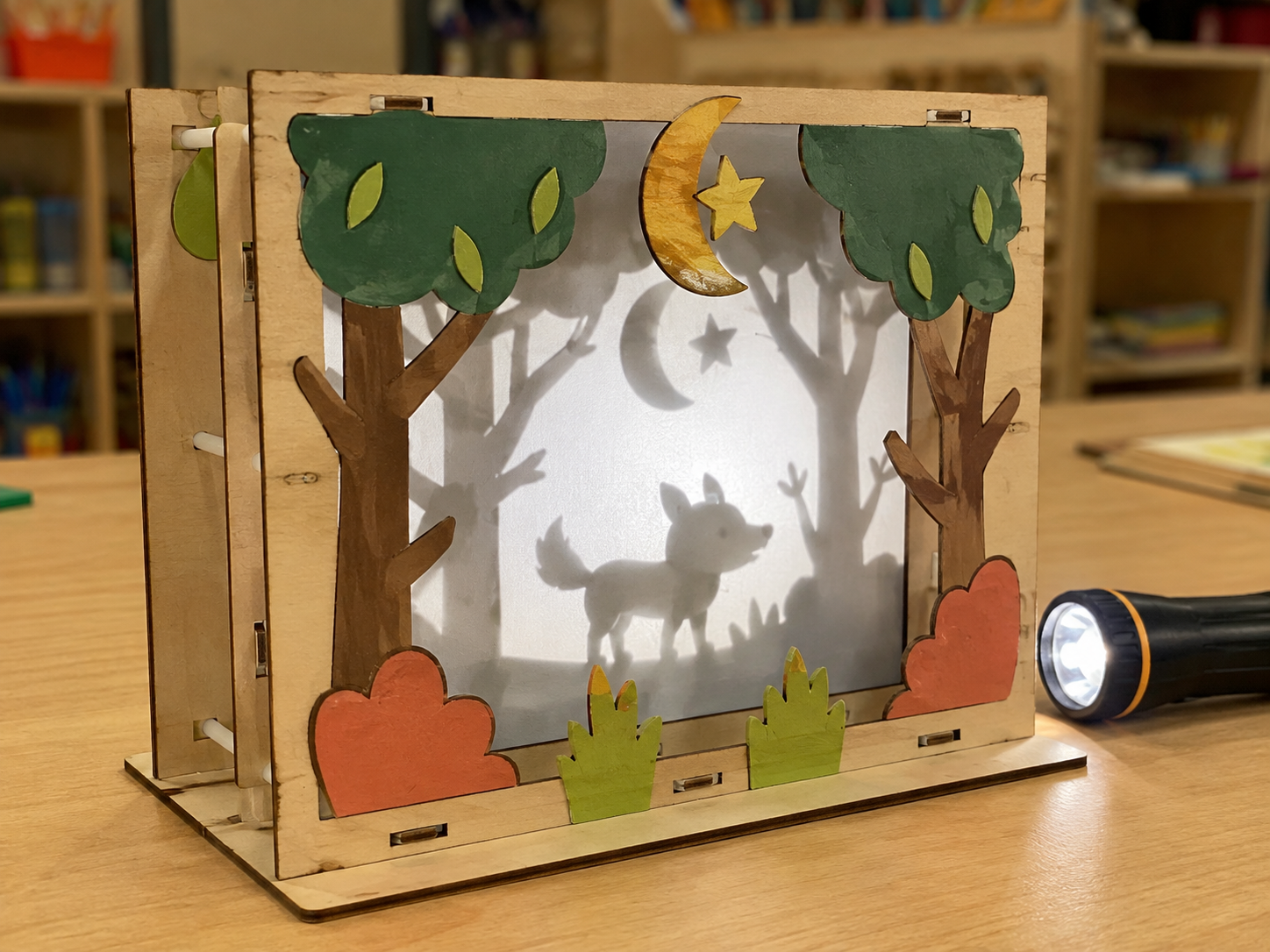
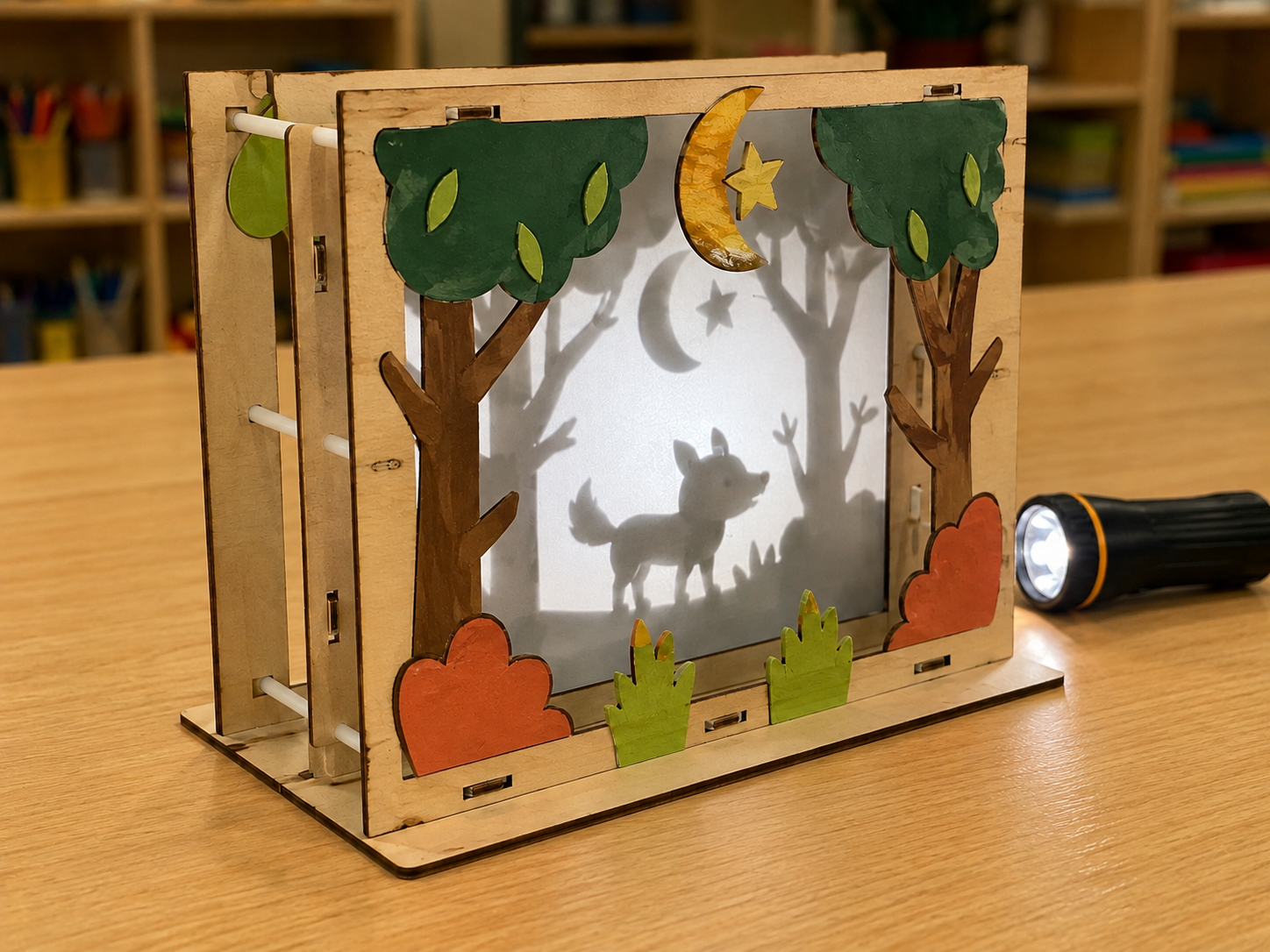
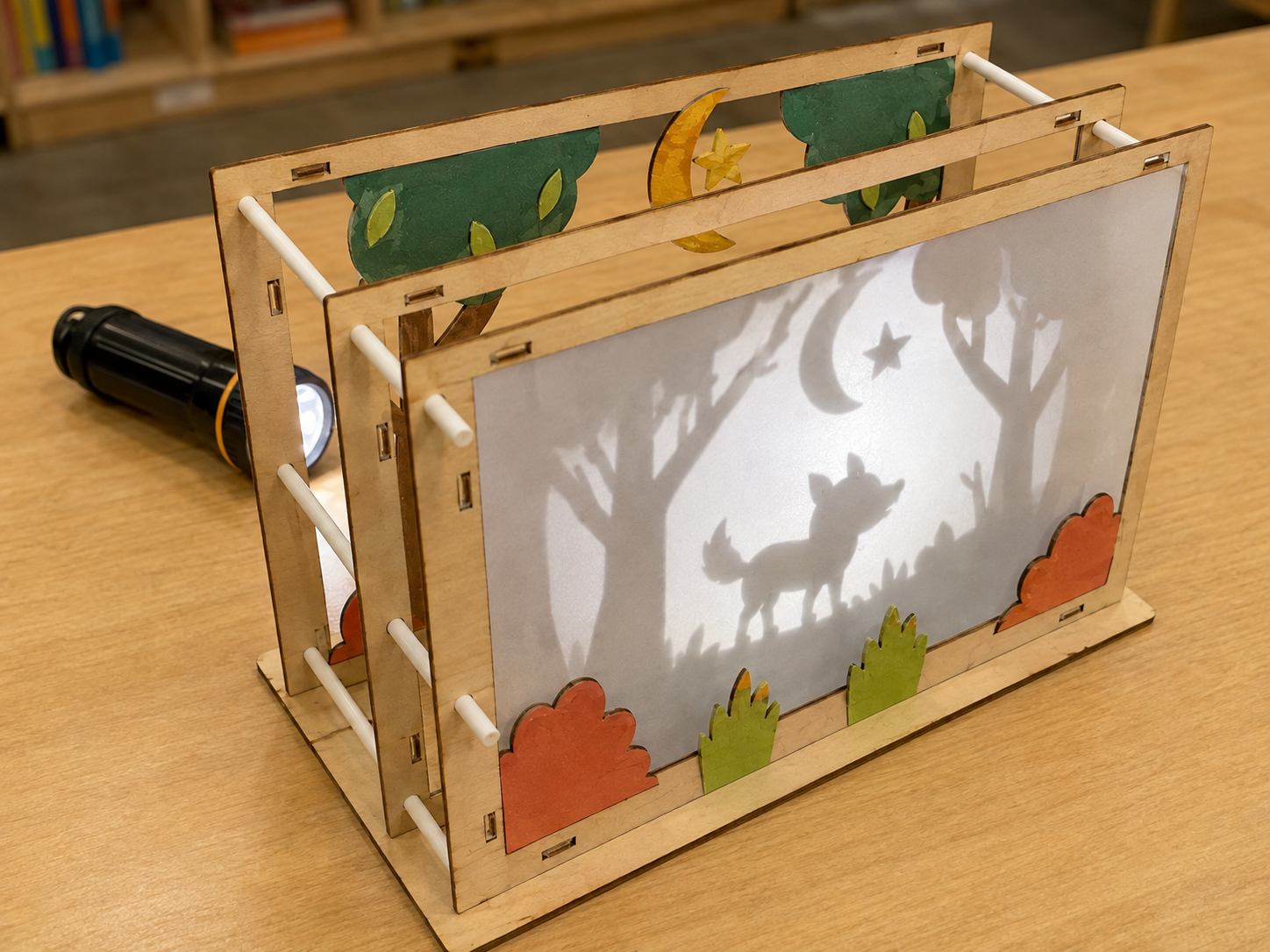
Use these images to understand the kind of making, details, and testing involved. They are inspiration—not designs students must copy.
Student quick guide
What are we doing?
Make three layers: a place, a character, and an action.
Shine a light, test the spacing, and fix the part that is hard to see.
For teachers
Engineering standards
This shows how the lesson connects to the national NGSS engineering standards and what student work you can collect.
Practiced
3-5-ETS1-1
Teams define what viewers must recognize and set limits for size, layers, and material.
What students show: Story goal, criteria, and constraints on planning sheet.Assessed
3-5-ETS1-2
Students compare two silhouette arrangements for clarity and strength.
What students show: Peer comparison notes tied to criteria.Assessed
3-5-ETS1-3
Teams hold light distance constant while testing layer spacing, then revise a failure point.
What students show: Fair-test table and revised arrangement.Materials
- Flashlights or LED lights
- White paper screens
- Black cardstock and index cards
- Pencils, tape, child-safe scissors
- Rulers and spacing blocks
- Computer with vector-drawing software
- Lab-approved laser material selected by trained adult
Teacher preparation
- Darken one demonstration area safely.
- Prepare a simple three-layer sample: setting, character, action/object.
- Create 2 cm and 4 cm spacing blocks.
- Confirm approved material and ventilation procedures for the exact xTool model.
- Set file rule: G5_Team##_Shadow_v1; use closed vector paths only.
Step by step
How to teach it
0–12 min
Discover shadows
- Move one shape closer to and farther from the light.
- Students notice changes in size, sharpness, overlap, and readability.
- Introduce silhouette and negative space.
12–27 min
Plan two stories
- Choose a simple moment with a setting, character, and action/object.
- Sketch two three-layer arrangements.
- Check that important shapes connect and small loose islands are removed.
27–48 min
Prototype and compare
- Cut rough cardstock versions.
- A partner identifies the story without being told.
- Compare which arrangement best meets the criteria: recognizable, sturdy, and visually clear.
48–60 min
Fair-test spacing
- Keep the flashlight and screen in fixed positions.
- Test only the layer spacing at 2 cm and 4 cm.
- Record which spacing improves clarity and why.
Day 2
Revise and fabricate
- Revise one failure point from peer or test evidence.
- Trace or redraw final closed vector shapes.
- Trained adult reviews and operates the laser cutter.
- Teams assemble, present, and reflect on how light and design worked together.
Assessment
- Scene communicates a recognizable setting, character, and action/object.
- Comparison uses the stated criteria rather than personal preference alone.
- Spacing test changes one variable and records observations.
- Final design addresses a documented failure point.
Supports & extensions
- Offer silhouette templates that students may combine and alter.
- Let students tell the story orally before drawing.
- Use high-contrast materials and tactile spacing blocks.
- Assign team roles: storyteller, shape designer, tester, recorder.
- Extension: test how changing light distance affects scale while spacing stays fixed.
Safety & responsible use
- Students do not operate the laser cutter.
- A trained adult verifies material, ventilation, focus, fire monitoring, and settings.
- Never laser-cut PVC, vinyl, unknown plastics, or unidentified coated materials.
- Use LED lights that remain cool and keep walkways clear in dim areas.
No-machine alternative
Create the final layers from black cardstock, recycled folders, or foam sheets using child-safe scissors. The engineering comparison and fair test remain unchanged.
Printable student design brief
The challenge
Build a three-layer shadow scene that lets another person recognize a story moment.
Success criteria
- Viewer recognizes the main idea
- Layers stay strong and connected
- Shadows remain clear when assembled
Constraints
- Exactly three main layers
- Fits inside a teacher-provided frame
- Only one test variable changes at a time
Engineer’s notes
Our viewer should notice…
Arrangement A works because…
The variable we changed was…
Our failure point was…
We revised… because the evidence…