Meet the real-world challenge: Help a classroom gardener notice dry soil without guessing or overwatering.
Grade 3 · Laser & Vinyl · Lesson 05
Smart Plant Guardian
Build a soil-checking helper that tells a classroom gardener when a plant may need water.
Time3 × 60 minutes + adult fabricationTeamsTeams of 3–4EquipmentBasic materials + optional moisture sensor + vinyl cutter
Project inspiration · 3 images
See, build, and test
Use these images to understand the kind of making, details, and testing involved. They are inspiration—not designs students must copy.
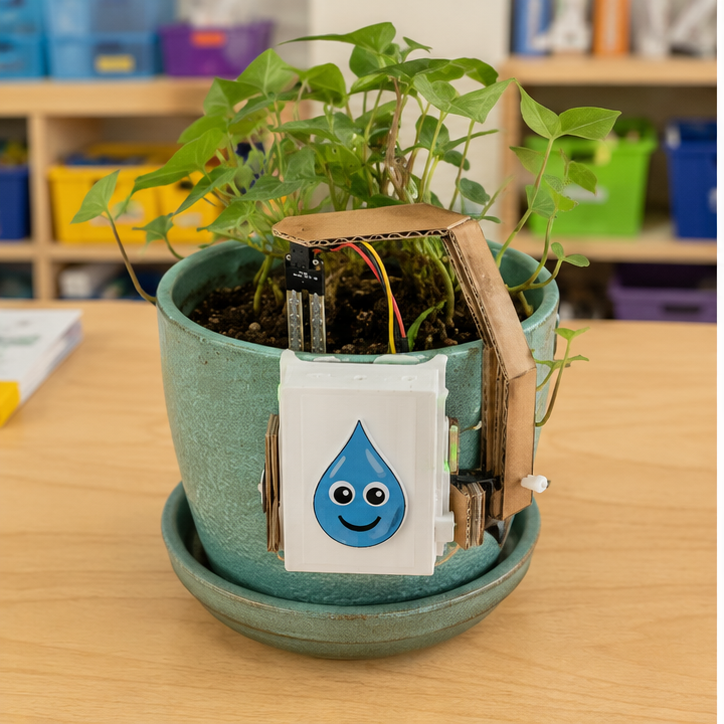
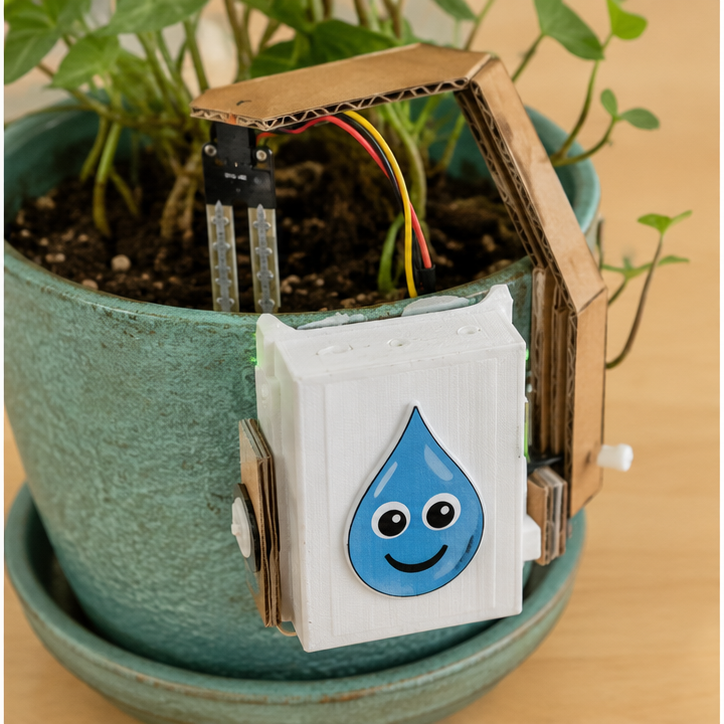
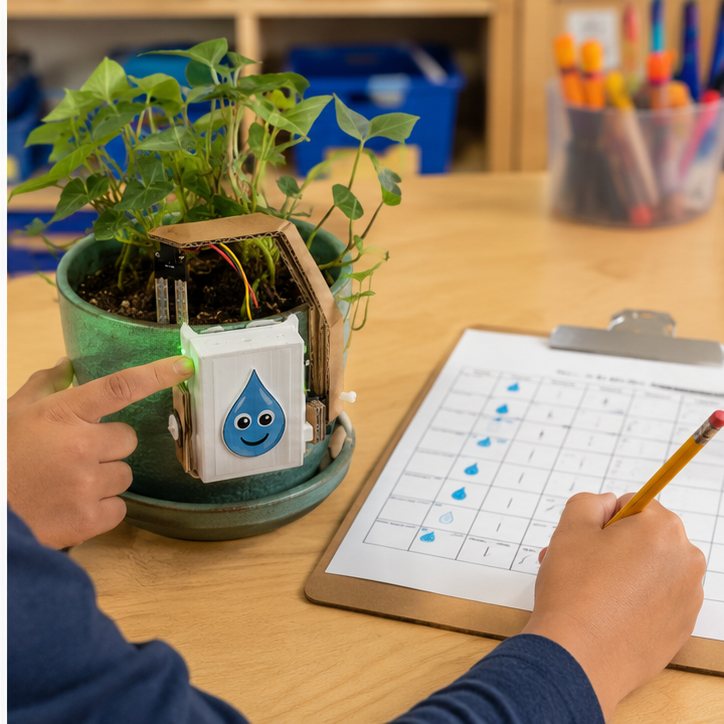
Student quick guide
What are we doing?
Choose materials, build the control system, and connect the soil sample, probe, or moisture sensor to the student-designed color, pointer, or LED signal.
Test the same way each time, study the evidence, and improve one part.
For teachers
Engineering standards
This shows how the lesson connects to the national NGSS engineering standards and what student work you can collect.
Assessed
3-5-ETS1-1
Teams define who needs the smart plant guardian and set measurable performance, safety, material, and time limits.
What students show: User-centered problem statement with criteria and constraints.Practiced
3-5-ETS1-2
Teams compare at least two circuit, code, or enclosure ideas against the success criteria.
What students show: Labeled system diagrams and a recorded design choice.Assessed
3-5-ETS1-3
Teams run a repeatable test—measure the same dry, damp, and wet soil samples in the same order—then change one variable and retest.
What students show: Test table, code or build revision, and evidence-based explanation.Materials
- Cardboard, paper, craft sticks, tape, reusable building pieces, and student-proposed materials
- Project platform: Basic materials + optional moisture sensor + vinyl cutter
- Breadboard, paper-circuit supplies, or low-voltage power when needed
- soil sample, probe, or moisture sensor input component or student-designed substitute
- student-designed color, pointer, or LED signal output component or student-designed substitute
- LEDs, resistors, jumper wires, copper tape, switches, and clips as needed
- Vinyl cutting materials for an optional case, sign, mount, or model
- Computer with approved coding or simulation tools when needed
- Planning sheet, ruler, and test-data table
Teacher preparation
- Build and test one possible reference solution without making it the required design.
- Prepare a basic-materials table plus optional electronics and fabrication stations.
- If coding is used, prepare a starter option for a student-written decision rule or optional if/then blocks; students may propose another workable control method.
- Prepare optional fabrication templates and a file rule beginning G3_05.
- Mark adult approval points before power-on and machine fabrication.
Step by step
How to teach it
Day 1 · 0–20
Meet the user and define success
- Introduce the application: Help a classroom gardener notice dry soil without guessing or overwatering.
- Identify the user, need, criteria, and constraints.
- Draw a system map with input → code → output.
Day 1 · 20–60
Build a first solution
- Choose basic, electronic, and fabricated materials based on the team's idea.
- Build with power disconnected whenever electronics are used.
- Complete an adult check, then troubleshoot one connection or physical feature at a time.
Day 2 · 0–30
Create the behavior
- Create the first working control using a student-written decision rule or optional if/then blocks.
- Predict what one rule, connection, or code change will do before testing it.
- Make the system understandable with labels, diagrams, comments, or coding blocks.
Day 2 · 30–60
Test and improve
- Use the same procedure each time: measure the same dry, damp, and wet soil samples in the same order.
- Record at least three results.
- Change one code, circuit, or physical-design variable and retest.
Day 3
Fabricate and present
- Design a vinyl cutting part that protects, mounts, or explains the electronics.
- Adult reviews and operates fabrication equipment where required.
- Connect the finished system and demonstrate how the evidence improved it.
Assessment
- Problem statement names a real user and measurable need.
- Circuit matches the team diagram and uses components safely.
- Program connects the intended input to the intended output.
- Test conditions remain consistent and include recorded evidence.
- Revision addresses a documented failure or user need.
Supports & extensions
- Use color-coded wires and a photograph of each breadboard step.
- Provide block coding or partially completed code with one change at a time.
- Assign roles: circuit builder, coder, tester, and recorder.
- Let students explain findings orally or with labeled diagrams.
- Extension: add a second sensor, output, data display, or operating mode.
Safety & responsible use
- Use only teacher-approved low-voltage classroom electronics; never connect projects to wall current.
- Disconnect power before changing wires or components.
- Use the correct resistor with every standard LED and stop immediately if a part becomes hot.
- An adult handles soldering, laser cutting, printer setup, blades, and final power approval.
- Keep liquids away from boards unless a sealed, teacher-approved sensor activity specifically requires them.
No-machine alternative
Build with cardboard, paper mechanisms, paper circuits, or a free on-screen simulator. Students may invent another safe way to model the same function, then compare ideas, test one variable, collect evidence, and revise.
Printable student design brief
The challenge
Create a working smart plant guardian for this need: Help a classroom gardener notice dry soil without guessing or overwatering.
Success criteria
- Shows a clear dry, damp, or wet signal
- Is easy for a student gardener to understand
- Keeps powered parts away from splashes
Constraints
- May be observational, mechanical, or electronic
- Sensor enters soil but powered parts stay dry
- Tests the same three samples each time
Engineer’s notes
Our user needs…
The input tells the system…
Our code decides…
The output responds by…
Our test data showed…
We improved… because…